Mexican Tortas: Homemade Telera Bread and Four Flexitarian Fillings
Tortas are Mexican sandwiches, but that description does not quite prepare you for the reality.
A proper torta is generous. It is layered. It is often toasted, pressed or warmed just enough to bring everything together. There may be creamy refried beans, avocado, cheese, grilled vegetables, fish, meat, pickled jalapeños, crunchy lettuce, and a salsa that slowly begins to run down your hands.
Food porn? I think so; it’s lip-smacking good.
But tortas are also practical, adaptable and deeply rooted in everyday Mexican cooking. They can be eaten for breakfast, lunch, dinner or as a substantial street-food snack. Much like tacos, they are not defined by one particular filling. They are a format: good bread carrying a carefully balanced combination of richness, freshness, protein, acidity, heat and crunch.
That makes the torta perfect for the way I like to cook: flexitarian, plant-forward and joyfully Mexi-terranean.
What Is a Mexican Torta?
In Mexican cuisine, a torta is a sandwich typically made with a soft white bread roll, such as a telera or bolillo. The bread is sliced and filled with ingredients that may include refried beans, crema or mayonnaise, avocado, tomato, lettuce, pickled chillies, cheese, eggs, grilled meat, milanesa, seafood or a prepared Mexican guisado – a cooked filling or stew.
There is no single definitive torta recipe. Regional versions, neighbourhood torterías and individual cooks all develop their own combinations.
The Mexican government’s cultural gastronomy guide describes the classic torta as beginning with fresh telera bread, commonly spread with refried beans and filled with cheeses, cold meats, pork, milanesa, carnitas, bacalao or other hot and cold preparations. Larousse Cocina similarly defines tortas through their bolillo or telera bread, creamy spreads, beans, vegetables and many possible fillings. edom is part of the appeal.
Just as I explain in my guide to what a taco really is, the format gives you structure without removing creativity. You respect the foundation and then decide what delicious direction you want to take.
Why Tortas Matter in Mexican Cuisine
Tortas are important because they make Mexican flavours portable, substantial and endlessly adaptable.
You can put a simple omelette, beans and jalapeños inside one. You can add a breaded milanesa and avocado. You can use carnitas, chicken tinga, chorizo, roasted vegetables, cheese, tuna, fish or yesterday’s stew.
A torta can be humble or completely excessive.
Some are everyday lunches. Others are deliberately enormous creations combining several meats, cheeses and sauces. Mexico City is famous for tortas loaded with everything imaginable, while regional versions such as Puebla’s cemitas and Guadalajara’s tortas ahogadas have their own bread, fillings and identities.
The torta therefore sits somewhere between a sandwich, a complete meal and a marvellous vehicle for leftovers.
And I mean “vehicle” quite literally. The bread must be able to transport a lot of delicious things without collapsing halfway through lunch.
How a Good Torta Is Assembled
A good torta should not simply be a random pile of ingredients.
Here is my torta-building system:
1. The bread
Use a fresh telera or bolillo when possible. The roll should be soft inside, with enough structure to hold sauces and fillings.
A good locally baked ciabatta can also work, especially when traditional Mexican bread is unavailable. I often use a naturally fermented ciabatta because I love its gentle tang, open aroma and soft but sturdy texture.
2. The creamy base
Refried beans are my first choice. They give the sandwich substance and stop vegetable fillings from feeling incomplete.
Mayonnaise, avocado crema or guacamole can be spread on the other side of the bread.
3. The main filling
This could be aubergine, mushrooms, tofu, halloumi, eggs, tuna, fried fish, chicken Tinga, pork like Cochinita Pibil or a prepared stew.
The main filling needs a distinct texture and enough seasoning to remain noticeable among all the other layers.
4. Freshness and crunch
Lettuce, cabbage, tomato, radish, cucumber, coriander or grilled corn bring freshness and prevent the torta from becoming one long, soft mouthful.
5. Acidity and heat
Pickled jalapeños, gherkins, onions, capers, salsa or a squeeze of lime cut through beans, avocado, cheese and fried ingredients.
This is the same balance I use in my Taco Craft system: every component should have a job.
Can a Mexican Torta Be Nutritious?
A torta is not automatically a nutritious meal simply because it contains avocado. Some versions are enormous, heavily fried and filled with processed meats, cheese and several rich sauces.
But my flexitarian format builds a very satisfying and well-balanced meal.
Refried beans contribute plant protein and fibre. Aubergine, lettuce, tomatoes, mushrooms and other vegetables increase the volume and variety of the filling. Avocado brings richness largely through unsaturated fats and also contributes fibre. Fish, tuna, eggs, tofu or modest portions of cheese can provide additional protein. My preferred formula is:
Bread + beans + vegetables + a deliberate protein + avocado + something fresh + something sharp and spicy
It is not about making a torta small, joyless or suspiciously “healthy.” It is about making its generosity work harder.
For more on this approach, read my Flexitarian Diet guide and my guide to cooking with beans as a nutritional powerhouse.
Telera, Bolillo and Birote: Choosing the Right Torta Bread
Proper bread is as important to a torta as a proper tortilla is to a taco.
Telera
A telera is a broad, oval Mexican roll with two distinctive grooves dividing the top into three sections.
It normally has a thin crust and a soft, relatively close interior. That soft crumb helps support generous fillings without forcing everything out of the opposite side when you take a bite.
Bolillo
A bolillo is usually longer and more tapered, with a central slash and a slightly crustier exterior. It is related in style to a small baguette, although its interior is generally softer.
Both bolillos and teleras are widely used for tortas.
Birote salado
Tortas ahogadas are a special case. These famous “drowned” sandwiches from Guadalajara, Jalisco, are traditionally made with birote salado, a salty, sturdy roll capable of absorbing tomato and chile sauces without immediately disintegrating. Traditional versions are commonly filled with carnitas and served with a tomato-based sauce and a much hotter chile de árbol sauce. Telera is excellent for an ordinary torta, but it is not the ideal bread for a properly drowned torta ahogada.

Homemade Mexican Telera Bread Recipe
This is the telera recipe I have tested at home. It produces eight soft rolls with a light crust and the characteristic three-part shape.
Telera bread ingredients
Makes eight teleras
- 500g all-purpose flour
- 10g fine salt
- 7g active dry yeast
- 300ml lukewarm water
- 25g softened unsalted butter
- 20g sugar
- A little neutral oil for greasing
How to make telera bread
1. Activate the yeast
Put the yeast into a small bowl with approximately 100ml of the lukewarm water and a teaspoon of the sugar.
Leave it for 5–10 minutes, until the mixture looks lightly foamy. The water should feel warm rather than hot.
2. Form the dough
Mix the flour, remaining sugar and salt in a large bowl.
Make a well in the middle and pour in the activated yeast mixture. Gradually add the remaining water, mixing until a rough dough forms.
Add the softened butter in small pieces and work it into the dough.
3. Knead
Turn the dough onto a clean surface and knead for approximately 7–10 minutes.
You want a soft, smooth and flexible dough. It may feel slightly tacky at first, but avoid adding too much extra flour or the finished teleras may become dry.
4. Complete the first proof
Lightly grease a bowl and place the dough inside. Turn it once so the surface receives a very thin coating of oil.
Cover with a clean kitchen towel or reusable covering and leave somewhere warm until doubled in size. This will normally take around one hour, although the exact time depends on your kitchen temperature.
5. Divide the dough
Press the risen dough gently to release excess gas.
Divide it into eight pieces of approximately 105g each. Shape them into balls, cover and leave to rest for 10–15 minutes.
This short rest allows the dough to relax and makes shaping easier.
6. Shape the teleras
Flatten each ball into a broad oval.
Using a thin wooden dowel, narrow rolling pin or the round handle of a wooden spoon, press two deep lines lengthwise into the dough.
Press firmly enough to create the traditional three-section shape, but do not cut completely through the roll.
7. Complete the second proof
Transfer the shaped rolls to a baking tray lined with parchment.
Cover loosely and leave them for approximately 40–50 minutes, or until noticeably puffed.
The grooves may begin to soften as the dough rises. Press them again gently before baking when necessary.
8. Bake
Preheat the oven to 190°C.
Brush the tops very lightly with water and bake for approximately 12–15 minutes.
Take them out when they are lightly golden. Do not wait for a thick, dark crust: a telera should remain soft enough to compress gently around its fillings.
Transfer to a wire rack and allow them to cool.
What Makes a Good Flexitarian or Mexi-Terranean Torta?
My Mexi-terranean approach combines the chilli-driven energy of Mexican cooking with the vegetables, pulses, olive oil, seafood and fresh flavours associated with Mediterranean food.
For tortas, that means:
- using beans as part of the foundation;
- giving vegetables a starring role;
- using cheese as a flavourful component rather than the entire meal and entirely optional;
- choosing fish and seafood rather than processed meat;
- adding pickles, herbs, tomatoes and fresh leaves;
- keeping sauces bold but controlled;
- and remembering that plant-forward food still needs texture, seasoning and joy.
For most of my tortas, I begin with refried beans on one side of the bread and avocado crema on the other.
From there, the fun starts.
Possible plant-forward proteins include crispy oyster mushroom milanesa, tofu, marinated soy curls, chickpea patties or roasted mushrooms.
Fresh toppings could include shredded cabbage, romaine lettuce, tomatoes, pickled jalapeños, caramelised onions, radishes, herbs or charred corn.
For more ideas, see my collection of plant-based Mexican tacos and my Mexican Salsa System.


Four Flexitarian and Mexi-Terranean Torta Recipes
1. Mexi-Terranean Aubergine and Halloumi Torta
This is probably the clearest expression of what I mean by a Mexi-terranean torta.
Aubergine loves oil, smoke and chilli. Halloumi brings salt, chew and those beautifully irresistible golden edges. Refried beans give the sandwich its Mexican foundation, while tomato and avocado crema keep everything fresh and generous.
Ingredients for four tortas
- 4 teleras or small ciabatta rolls
- 1 large aubergine
- 200g halloumi
- 250g warm refried beans
- 180–200g avocado crema
- 2 ripe tomatoes, sliced
- A handful of lettuce or rocket
- 2 tablespoons olive oil
- 1 teaspoon chipotle paste or chilli sauce
- Juice of ½ lime
- Black pepper
- Pickled jalapeños, optional
Method
Slice the aubergine into rounds approximately 1cm thick.
Brush with olive oil and cook in a hot frying pan or griddle until completely tender and browned on both sides. Aubergine that is still spongy in the middle is not ready.
Season with black pepper and brush lightly with chipotle paste mixed with lime juice.
Slice the halloumi and fry in a dry or very lightly oiled pan until golden.
Cut the rolls and toast the inner surfaces briefly.
Spread refried beans over the bottom half and avocado crema over the top. Layer on the lettuce, aubergine, halloumi and tomato.
Finish with pickled jalapeños or a few drops of hot sauce.
Close, press gently and eat while the halloumi is still warm.
2. Tuna, Egg and Grilled Corn Torta
Tuna and boiled egg already belong together. Add creamy beans, avocado, grilled corn and sharp pickles, and the result becomes much more exciting than an ordinary tuna sandwich.
This one feels substantial without needing a large amount of fish.
Ingredients for four tortas
- 4 teleras or ciabatta rolls
- 2 cans tuna, approximately 250g drained weight
- 4 eggs
- 250g refried beans
- 180g avocado crema
- 150g cooked corn kernels
- 2 tomatoes, sliced
- 4–6 gherkins or pickled cucumbers, sliced
- Lettuce
- Juice of 1 lime
- 1 tablespoon olive oil
- Black pepper
- Pickled jalapeños, optional
Method
Boil the eggs to your preferred firmness, cool, peel and slice.
Cook the corn in a dry frying pan until it develops a little colour. Season with lime juice and black pepper.
Drain the tuna and mix it gently with olive oil, a squeeze of lime and black pepper. Do not turn it into paste; some texture is welcome.
Toast the cut sides of the bread.
Spread the bottom with refried beans and the top with avocado crema.
Add lettuce, tomato, tuna, sliced egg, grilled corn and pickles. Finish with jalapeños when you want more heat.
The pickles are not optional in spirit, even if they are technically optional in the recipe. This torta needs that sharp little punch.
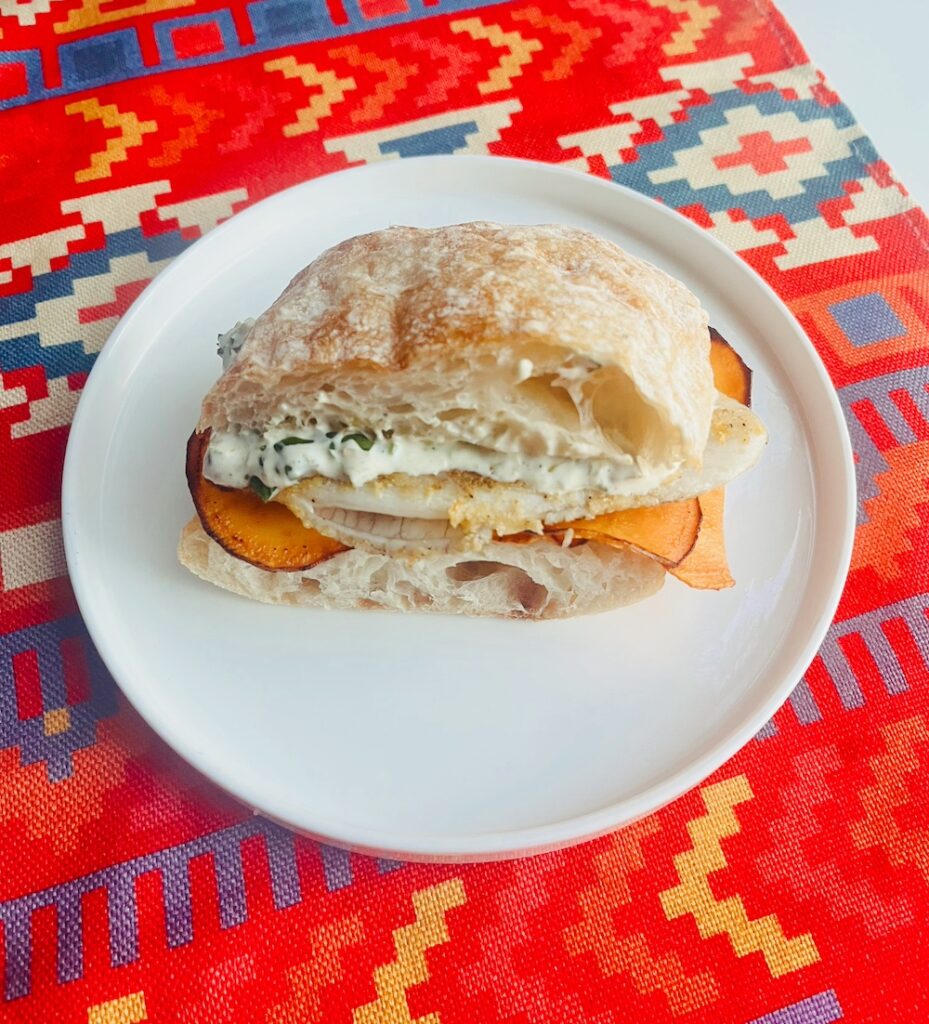
3. Fried Fish and Chips Torta with Jalapeño Tartar Sauce
This torta was inspired by the fish sandwich in Thomasina Miers’ Mexican Table, one of the books included in my guide to the best Mexican cookbooks.
The idea is essentially fish and chips meeting a Mexican torta.
And honestly, why did we wait so long?
You have crisp fish, hot potatoes, pickled chilli and herby tartar sauce inside bread. It is indulgent, ridiculous and very satisfying.
This is also the exception to my usual avocado-crema rule. Tartar sauce already provides plenty of richness, and adding several creamy sauces only makes flavours less distinct.
Even systems need exceptions.
Ingredients for four tortas
For the fish
- 4 firm white fish fillets, approximately 500–600g in total
- 60g plain flour
- ½ teaspoon smoked paprika
- Salt and black pepper
- 30g butter
- 2 tablespoons neutral oil
- 4 teleras, bolillos or ciabatta rolls
- 250–300g cooked fries or thin roasted potatoes
- 200g refried beans, optional but recommended
- Shredded cabbage or lettuce
For the jalapeño tartar sauce
- 180–200g good-quality mayonnaise or thick Greek yoghurt
- 3 tablespoons capers, finely chopped
- 40g gherkins, finely diced
- 1 small shallot, finely diced
- 2–3 tablespoons pickled jalapeños, finely chopped
- 1–2 teaspoons jalapeño pickling liquid
- A handful of dill and parsley, finely chopped
- Finely grated zest of 1 lemon
- Black pepper
Method
Mix all the tartar sauce ingredients and refrigerate while you prepare the fish.
Combine the flour, paprika, salt and pepper on a plate.
Pat the fish dry and coat it lightly with the seasoned flour.
Heat the butter and oil in a frying pan. Fry the fish until golden outside and opaque through the centre. The cooking time will depend on the thickness of the fillets, so watch the fish rather than the clock.
Warm the fries and toast the bread.
Spread a thin layer of refried beans on the bottom half of each roll. Add cabbage or lettuce, followed by the fish and a small handful of fries.
Spoon over the jalapeño tartar sauce.
Serve with extra pickled chillies and don’t forget about several napkins.
Read more about why crispy fish works so beautifully with Mexican flavours in my guide to fish tacos and tuna tostadas.
4. Aubergine a la Veracruzana Torta with Chickpeas
I find Veracruz-style preparations to be a natural bridge between Mexican and Mediterranean cooking.
Tomatoes, olives and capers are cooked with chillies and aromatics to create a savoury, sharp and deeply satisfying sauce. The preparation is particularly associated with fish, but the flavour system works beautifully with aubergine.
Aubergine absorbs the tomato, chipotle, olive and caper flavours as it cooks. Chickpeas add extra substance and make the stew much more useful as the main filling of a plant-forward torta.
I sometimes replace the capers with jonjoli, the pickled Georgian sprouts frequently served as part of a Georgian table. They are not identical, but they provide a similarly sharp, salty and botanical accent.
This is Mexico, the Mediterranean and Georgia all trying to fit inside one telera.
Thankfully, the telera is generous.
Veracruz-style aubergine and chickpea stew
Makes enough for approximately four tortas
Ingredients
- 2 medium aubergines, approximately 700g
- 1 medium onion, finely chopped
- 3 garlic cloves, finely chopped
- 400g chopped tomatoes
- 240g cooked chickpeas, drained
- 80g green olives, sliced
- 2 tablespoons capers or drained jonjoli
- 1–2 tablespoons chipotle paste, to taste
- 1 teaspoon dried Mexican oregano
- 2–3 tablespoons olive oil
- 100ml water, as needed
- Juice of ½ lime
- Salt and black pepper
Method
Cut the aubergines into bite-sized cubes.
Heat one to two tablespoons of oil in a wide frying pan. Cook the aubergine in batches, so it browns rather than steams.
Add a little more oil only when necessary. Aubergine will absorb everything you give it, so do not keep pouring without judgement.
Once browned and beginning to collapse, transfer the aubergine to a plate.
Add the onion to the same pan and cook until soft and translucent. Add the garlic and cook for another minute.
Stir in the chipotle paste and oregano.
Add the chopped tomatoes, olives and capers or jonjoli. Return the aubergine to the pan.
Simmer gently for 15–20 minutes, adding a splash of water when the mixture becomes too dry.
Once the aubergine is completely tender and the sauce has become rich and cohesive, fold in the chickpeas. Cook for another five minutes.
Taste before adding salt because both the olives and capers are already salty.
Finish with black pepper and lime juice.
The finished stew should be thick enough to sit inside a roll. It should not run across the plate like soup.
Assembling the Veracruz aubergine tortas
For four tortas, you will need:
- 4 fresh teleras
- 250g refried beans
- Approximately 180g avocado crema
- Lettuce
- Sliced tomato
- One batch of Veracruz-style aubergine and chickpeas
- Pickled jalapeños or hot sauce
Toast the cut surfaces of the teleras briefly.
Spread refried beans over the lower half and avocado crema over the upper half.
Add lettuce and tomato, followed by a generous spoonful of warm aubergine and chickpea stew.
Finish with jalapeños or hot sauce.
Close the torta and allow it to sit for one minute before eating. This gives the bread a chance to absorb a little of the Veracruz sauce without losing its structure.
My Verdict: Tortas Deserve More Attention
Tacos receive most of the international attention, and I obviously understand why. I have built a considerable part of my food life around them. But tortas deserve their own moment.
They are generous without requiring complicated presentation. They are perfect for cooked vegetables, leftover stews, beans, grilled cheese, tuna, eggs and fish. They can be traditional, completely excessive or thoughtfully flexitarian.
Most importantly, a torta can be a proper meal.
For my ideal version, I want good bread, a thin layer of refried beans, something creamy, plenty of vegetables, a deliberate main filling and enough acidity to keep me reaching for the next bite.
The halloumi and aubergine torta is salty, smoky and immediately satisfying. The tuna torta feels fresh yet substantial. The fish and chips torta is glorious comfort food. And the Veracruz aubergine torta is perhaps the most complete expression of my Mexi-terranean philosophy: Mexican technique and chilli energy meeting Mediterranean ingredients, Georgian improvisation and a plant-forward way of eating.
The bread is important. So bake the telera when you have time. But feel free to use good ciabatta when you do not. But whichever bread you choose, please do not make a boring sandwich. Make a torta.
[Tacos Craft | Tortillas and Masa | Salsa Magic]
Here are my most used and loved tools and ingredients for joyful Mexican cooking:
Masa harina for tortillas: Masienda, Bob’s Red Mill, Maseca
Chillies: Chipotle, Ancho, Guajillo, Tajin
Tools: Tortilla Press, Ninja blender, Global knives.
Mexican Torta FAQ
What is a torta in Mexican cuisine?
A Mexican torta is a sandwich commonly made with a telera or bolillo roll and filled with beans, avocado, vegetables, cheese, eggs, meat, fish, milanesa or cooked Mexican fillings.
What is the best bread for a Mexican torta?
Telera and bolillo are the most common choices. Telera is broad and soft with two grooves on top, while bolillo is usually longer and slightly crustier. Torta ahogada traditionally requires the sturdier birote salado.
Can I use ciabatta for a torta?
Yes. Ciabatta is not traditional, but a fresh, relatively soft ciabatta is a practical substitute when Mexican bread is unavailable. Avoid a roll with an extremely hard crust, as it will force the fillings out when bitten.
Are Mexican tortas always made with meat?
No. Tortas can be filled with beans, eggs, cheese, avocado, vegetables, mushrooms, tofu, fish or meat. Their flexibility makes them particularly suitable for vegetarian and flexitarian cooking.
Can telera dough be prepared in advance?
Yes. After kneading, place the covered dough in the refrigerator for a slow overnight rise. Bring it back towards room temperature before dividing, shaping and completing the second proof.
How do I stop a torta from becoming soggy?
Use a fresh but structured roll, keep wet sauces relatively thick and place protective layers such as beans, avocado, lettuce or cheese between the bread and juicier fillings. Assemble very saucy tortas shortly before serving.

By Dito
Restaurateur. Wine Expert & Educator (dipWSET). Flexitarian Chef. Senior Marketer. Entrepreneur.
Learn more about Dito